

When a Virus Steps on a Mine: Ancient Mechanism of Infected Cell Self-Destruction Discovered

When a virus enters a cell, it disrupts the cell’s normal functions. It was previously believed that the cell's protective response to the virus triggered cellular self-destruction. However, a study involving bioinformatics researchers at HSE University has revealed a different mechanism: the cell does not react to the virus itself but to its own transcripts, which become abnormally long. The study has been published in Nature.
Many viruses act in a similar way: they block the activity of cellular genes and reprogram the cell to produce viral proteins. As a result, the cell stops making its protective molecules and becomes vulnerable. However, as researchers have discovered, this process can sometimes backfire against the viruses themselves.
Biologists and bioinformatics researchers from the USA, the UK, Germany, China, and Russia have investigated how cells are able to recognise a viral attack. The researchers infected cells with herpes and influenza viruses and used RIP sequencing to analyse the cells. This technology makes it possible to isolate RNAs associated with specific proteins within a cell and thereby observe how the activity of cellular genes changes after infection.
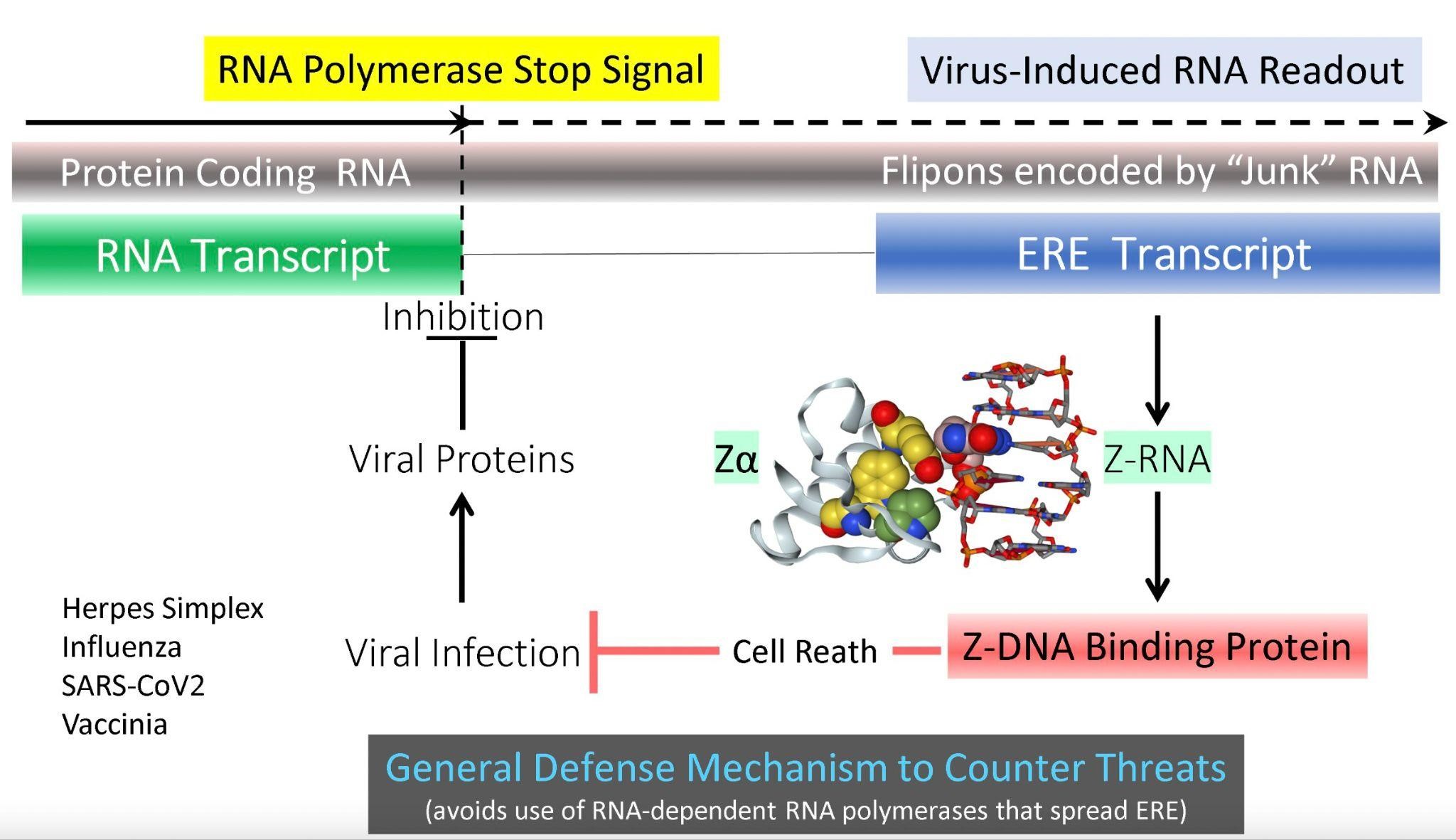
The analysis revealed that viral proteins prevent the cell from properly completing transcription—the process of reading information from DNA. As a result, RNA synthesis fails to stop at the right time, producing excessively long molecules instead of the required transcripts. These elongated RNAs contain fragments of 'junk' DNA—ancient viral insertions that have accumulated in our genome over millions of years of evolution. Under normal conditions, these regions remain inactive, but when transcription goes awry, they are read and form structures with a unique shape: left-handed double helices, known as Z-RNA.
An increased number of such molecules is perceived by the cell as a danger signal. Their recognition is carried out by the ZBP1 protein, a sensor of intracellular immunity. As soon as it detects the accumulation of Z-RNA, the cell activates a self-destruction program—apoptosis or necroptosis. As a result, the virus does not have time to exploit the cell’s resources for its own replication.

Maria Poptsova
'It turns out that when a virus tries to suppress the activity of cellular genes and exploit the cell’s resources for its own replication, it triggers the cell’s self-destruction mechanism. It’s as if the virus steps on a mine laid by innate immunity: the cell dies along with the virus, preventing its further spread,' comments Maria Poptsova, Head of the Centre for Biomedical Research and Technology at the HSE Faculty of Computer Science.
The scientists suggest that this protective mechanism may also operate in other viral infections that disrupt the transcription process. Moreover, the researchers were able to reproduce the same effect artificially: the drug JTE-607, currently in clinical trials as an anticancer agent, also induces the formation of Z-RNA. This mechanism could potentially be harnessed in therapy—for instance, to selectively trigger the death of cancer cells or to enhance the immune response.
The study was conducted with support from HSE University's Basic Research Programme within the framework of the Centres of Excellence project.

See also:

AI Users Earn Up to 41.8% More Than Non-Users
Research conducted by economists at HSE University has revealed a significant correlation between the regular use of GenAI in the workplace and higher pay among Russian employees. The study found that individuals who frequently use GenAI in their professional activities earn notably more than those who reject these new tools or resort to them occasionally. The salary premium for highly qualified specialists reaches 41.8%. The article was published in the Voprosy Ekonomiki journal.
Personal Interest in Doctoral Thesis Topic Most Important for Confidence in Successful Defence
A researcher at HSE University analysed data on 1,539 doctoral students from 161 Russian universities to identify which features of a thesis topic are associated with academic success and engagement. The most important factor was found to be personal interest in the research topic, which was associated with almost all key aspects of doctoral programme experience—from engaging with the academic supervisor to research activity and confidence about successfully defending the thesis. The findings have been published in Higher Education.
Researchers Develop Methodology to Assess the Quality of Legal Representation in Criminal Proceedings
Having a good defence attorney in criminal proceedings can largely determine whether a defendant retains their freedom, health and good name. Researchers at HSE University propose a method for predicting an attorney’s performance based on the outcomes of their previous cases. The methodology takes into account the severity of the charges, the complexity of the cases, and the most likely outcome, drawing on judicial statistics.
When Pictures Hinder Understanding: Illustrations May Impede Learning of Abstract Ideas
Illustrations can help remember specific actions but do not always make abstract ideas easier to learn. Researchers from HSE University and Humboldt University compared how people learn from texts with different levels of abstractness. They found that participants remembered illustrations better and performed better on related tasks after reading a multimedia text about yoga asanas than after reading an abstract text about the Nash equilibrium. The findings could help improve the selection of illustrations for educational and informational materials. The study has been published in Learning and Instruction.
HSE Researchers Present Study on Neural Network Robustness in Video Analysis at ChinaMM 2026
Researchers from HSE University presented a study at the international ChinaMM 2026 conference on how video transmission distortions affect the performance of neural networks. The authors proposed a new approach to testing the robustness of such models under conditions that closely resemble the real-world use of video services.
HSE University to Develop Predictive Analytics System for Icebreaker Motors
Industrial automation is one of the key applications of artificial intelligence. A predictive analytics system for large electric motors is among the solutions being developed for the industry as part of HSE University’s Strategic Technological Project ‘Multi-Agent Platform of AI Solutions for Industry-Specific Tasks.’ What is predictive analytics, how can it improve the operation of electric motors, and what specialists joined forces to develop this technology? Anton Zarubin, Dean of the School of Computer Science, Physics, and Technology at HSE University–St Petersburg and the project development coordinator, explains in this interview with the HSE News Service.
Scientific Expedition to Hainan: HSE Scientists Organise Conference on Statistical AI in China
The Statistical AI Conference was held in Sanya, Hainan Island, China, from 24 to 28 August 2026. The international event brought together leading experts in statistics, machine learning, and applied AI. Alexey Naumov, Director of the AI and Digital Science Institute at the HSE Faculty of Computer Science, and Sergey Samsonov, Head of the International Laboratory of Stochastic Algorithms and High-Dimensional Inference, were among the conference organisers.
How to Assess Students’ Knowledge in the Age of AI
A researcher at HSE University has proposed a flowchart to help lecturers decide how to assess students who use artificial intelligence. It shows where the use of AI should be restricted and where it can be incorporated into the learning process. The article has been published in IT Professional.
5th Fall into ML Conference to Bring Together Leading AI Researchers
The AI and Digital Science Institute at the HSE Faculty of Computer Science invites researchers, developers and everyone shaping the future of technology to the fifth, anniversary edition of the Fall into Machine Learning conference (Fall into ML 2026). The event will take place on October 23–24, 2026, at the HSE Cultural Centre in Moscow and will become the key meeting point for Russia’s AI community.
HSE University to Present Its Projects at the International Youth Festival
The International Youth Festival (IYF) will be held in Yekaterinburg from 11 to 17 September 2026. HSE University will take an active part in the event. The university's booth will present a space settlement mock-up, robots, and the iFORA big data analysis system. Fifty HSE students will visit festival venues, and experts will participate in the business programme.